
Duluth City Directory Collections
Duluth Public Library is the main starting point for historical Duluth city-directory work. Its genealogy page describes directories as 1883 to present, while its in-library description specifically identifies 1884 through 1960 holdings and searchable access through Ancestry Library Edition. Those overlapping Duluth catalog dates describe access paths, not one guaranteed uninterrupted run. The Duluth library also directs researchers to local indexes and history resources, so a Duluth directory entry can be tested against obituary, death, birth, marriage, newspaper, and map material.
| Collection or record | Years described | Where held | Access |
|---|---|---|---|
| Duluth city directories | 1883 to present catalog description; 1884 to 1960 specifically described | Duluth Public Library | In person and searchable through library Ancestry access |
| Overlapping Duluth directory run | 1882 to 2002, with some missing | UMD house-history guide | Check the catalog and staff for the issue needed |
| Duluth City Directory 1922-1923 | 1922 to 1923 item | Minnesota Digital Library | Digitized item with collection search tools |
| Obituary and vital-index leads | Varies by index | Duluth Public Library online genealogy | Use an index to locate an underlying record or notice |
Call the library before making a long trip for one issue. Duluth's catalog notes no located issues for 1919, 1933, 1945, 1947, 1949, 1953, and 2008. A gap can reflect a missing volume, not a vanished household. The Main Library is at 520 W Superior St and can be reached at 218-730-4200. Duluth Public Library's genealogy-at-the-library page is the current access reference.
Duluth Directory Access Routes
Several Duluth channels solve different access problems. Ancestry Library Edition is available inside the library through the City of Duluth subscription. It includes census, passenger, military, vital, family-history, and local-history material, but it is not a citywide Duluth resident registry. The Minnesota Digital Library provides a sharable digitized Duluth directory citation, yet its item image and page indexing should be checked before treating a page as legible evidence. A search result is the beginning of a citation, not the citation itself.
Duluth Public Library's online genealogy menu adds the Biography File Index, Duluth Area Obituary Index, St. Louis County Death Index, Birth Index, MOMS marriage index, Minnesota People Search, and local links. For a missing Duluth book or unclear entry, use the physical Duluth library, in-library databases, librarian help, UMD Archives, the Historical Society, and the relevant government custodian rather than assuming online search is complete.
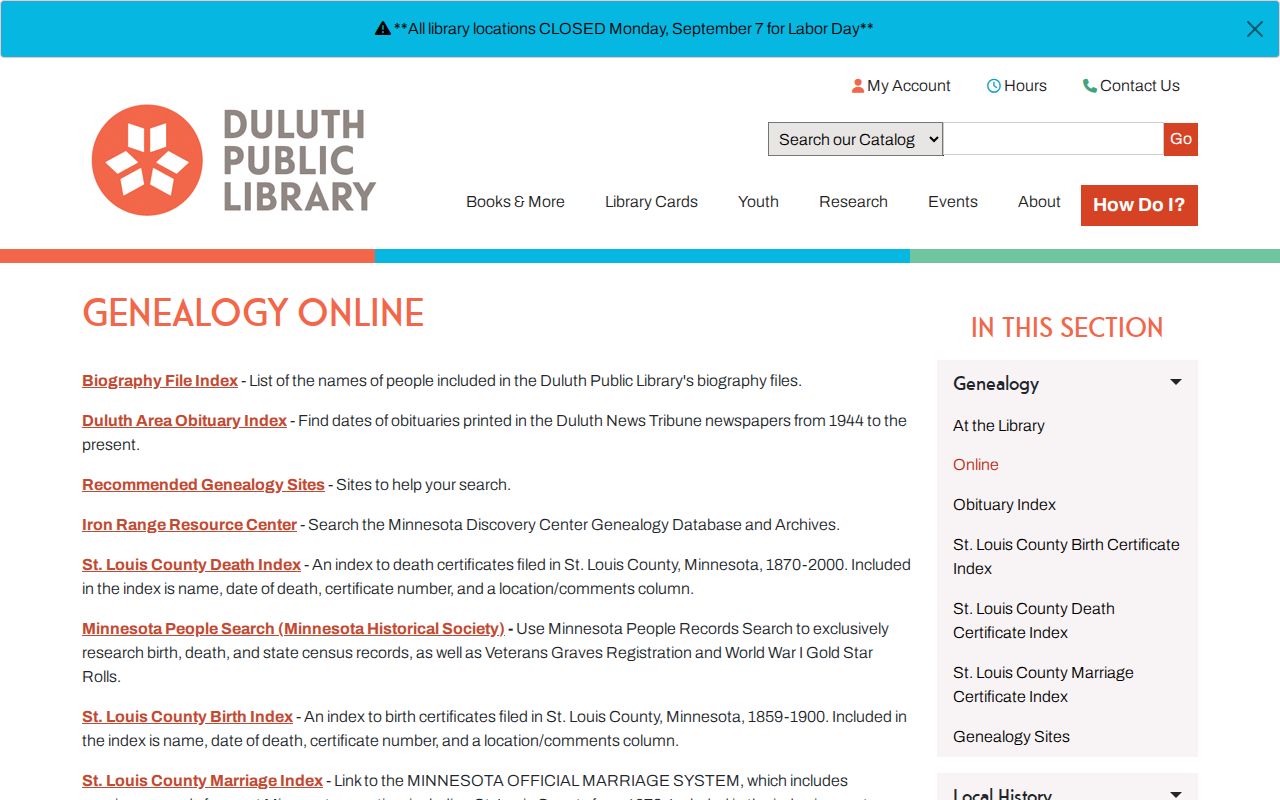
The library's index menu shows why directory research often needs a second source. A name found in a Duluth directory may be tested with an obituary, death-index entry, or newspaper reference without turning any index into proof by itself.
Duluth's 1930 Directory Turn
For a Duluth house or block question, 1930 is the key Duluth directory year. Duluth Public Library identifies it as the first street-by-street listing. Earlier Duluth volumes are mainly alphabetical resident and business lists, so they are best used to find a name, occupation, or address first. After 1930, the Duluth street section can add nearby households and make a move easier to see. The two formats describe different populations and should not be forced to give the same answer.
- Find the person in an alphabetical Duluth entry and note the spelling, occupation, and address exactly as printed.
- Check the prior and next available issue for the same name or address.
- For 1930 and later, use the street listing to place that address among nearby entries.
- Compare the result with a census, newspaper, deed, permit, or vital index that has its own date and purpose.
This local turning point matters because a directory is not a census. An alphabetical book can show an individual or business contact, later street pages add address context, census material can describe a household, and a deed records a property instrument. Keeping those roles apart prevents a false family connection.
Reading Duluth City Directory Entries
A Duluth city directory entry commonly supplies a surname, given name or initials, occupation, residence or street address, and sometimes a business address or a residence notation such as h or r. The exact visible example from the digitized item was not retained in available metadata. A real page should be transcribed only after its scan is open, with the volume title, issue year, page or image, and page-image quality recorded alongside it.
| Name as printed | Capture initials, spelling, suffixes, and variants rather than silently modernizing them. |
|---|---|
| Occupation or business | A useful locator that can distinguish two people with the same name. |
| Residence or street address | An observation for that issue, not a promise that every household member lived there. |
| Business address | Keep it separate from a home address when the entry supplies both. |
| Page and source | Record the title, year, page or image, collection, scan link, and adjacent years checked. |
- Criss-cross directory
- The street-order part of a later directory, used after an address is known to see entries along that street.
- Householder index
- An index organized around household or address information, which may not name every person in the home.
- Abbreviation key
- The front or back matter explaining a volume's marks; note it before interpreting shorthand.
A surname alone is weak. Pair the printed Duluth form with an occupation, dated address, source page, and corroborating Duluth record before treating it as the right person.
Duluth Directory Catalog Gaps
Duluth's two institutional descriptions do not need to be reconciled into a falsely complete series. Duluth Public Library describes its directory holdings from 1883 to present and singles out 1884 through 1960 for in-person and Ancestry access. UMD's guide describes an overlapping 1882 through 2002 run with some missing issues. Each is a useful catalog claim, and each calls for confirmation when a particular year is central to a family or address question.
Missing issues have practical effects. A disappearance between available volumes might mean a move, death, changed initials, unlisted status, a missing issue, or a damaged scan. Search spelling variants, married-name changes, businesses, and adjoining years. For the modern address chain, the Duluth street directory route focuses on county and city records rather than the historical shelf.
Note: Do not infer a date of death or a move solely from a name's absence in one directory issue.
Tracing Duluth Directory Households
Use a date ladder when following a Duluth household. Start with the first available directory appearance, preserve the wording of the entry, and move forward and backward through available issues. Log each address change with the printed name, occupation, address, issue year, page or image, and a note about the source used to check it. This turns a stack of hits into an evidence trail another family member can review.
- Locate the earliest available name entry and save its exact citation.
- Follow the person through adjoining directory years, recording changed addresses or work descriptions.
- For post-1930 entries, inspect the street-order section for address context.
- Pair the period with an available census record, then compare names and address details.
- Use obituary, death, marriage, newspaper, deed, or permit records to resolve a disappearance or same-name conflict.
Duluth directories are helpful between census years, but they remain snapshots. A boarder, owner, widow, or business contact can appear without representing all residents at a Duluth address. When a historical Duluth find needs a modern, name-indexed check, a separate Duluth resident lookup workflow keeps the older directory source distinct from the current record source.
Duluth Directory Corroboration
Duluth Public Library offers an unusually deep companion shelf: obituary, death, birth, and marriage indexes; newspapers; clipping files; maps; Ancestry Library Edition; and house-history referrals. The Duluth Area Obituary Index covers Duluth News Tribune obituaries from 1944 to present. The St. Louis County Death Index covers 1870 through 2000, and the library's Birth Index covers 1859 through 1900. These are locating tools. The underlying certificate or other custodian record is stronger when legal proof is needed.
Duluth Public Library's in-library genealogy collection documents the physical and subscription route to its directory volumes.
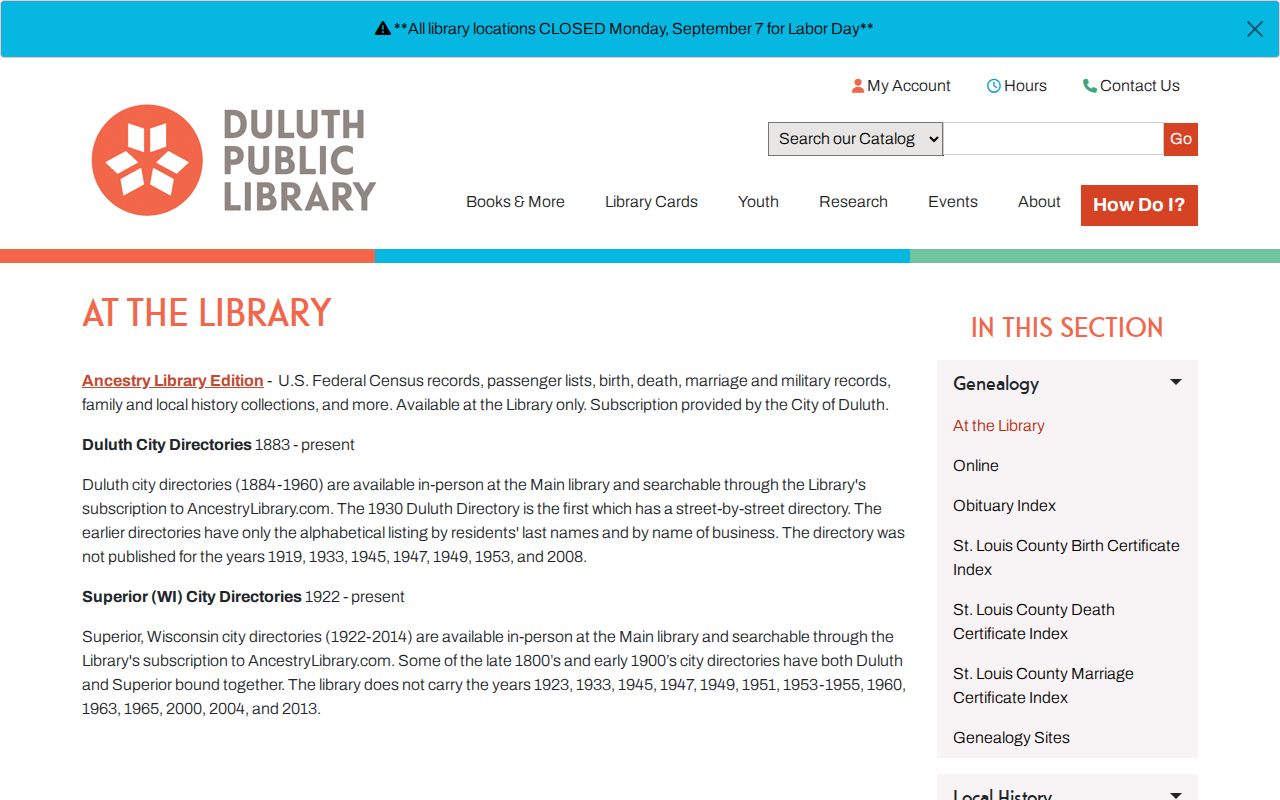
The holdings screen is a reminder to keep the volume year, catalog description, and access method with every Duluth directory note. That preserves the difference between a library-held issue and a digitized item.
Duluth's 1888 Phone Card
A local newspaper's account of Duluth's first phone directory gives a small records-history marker: in 1888 it was a three-by-six-inch card with 30 numbers. The card is not a city directory, and it should not replace library volumes. Its value is comparative. It shows how limited telephone listings were while the directory tradition was developing, and why the two source types should be cited separately.
St. Louis County was created in 1856 and the Duluth courthouse was built in 1909, while city directories begin in the 1880s. Early research may move among city, county, church, newspaper, business, and later state sources. One result is rarely the whole account. The story provides local context, then the directory page, issue, and accompanying evidence do the identification work.
Duluth Directory Maps and Photos
When an entry points to a house, add place records without confusing them with occupant proof. Duluth's house-history route can bring together assessor material, CSI permit or blueprint records, directories, newspapers, abstracts, Sanborn plates, Rascher maps, and atlases. The Library of Congress provides digitized Duluth fire-insurance map sets, including 1884 and 1908 material. Those plates show building footprints, construction, use, and fire-risk context, not who lived inside.
UMD Archives and Special Collections is another channel, by appointment Monday through Friday from 9 to 4 at Kathryn A. Martin Library. Its house-photo index covers more than 2,500 addresses, 7,514 prints or negatives, and 2,880 houses, mostly east of Lake Avenue and dating from the 1870s through the 1980s.
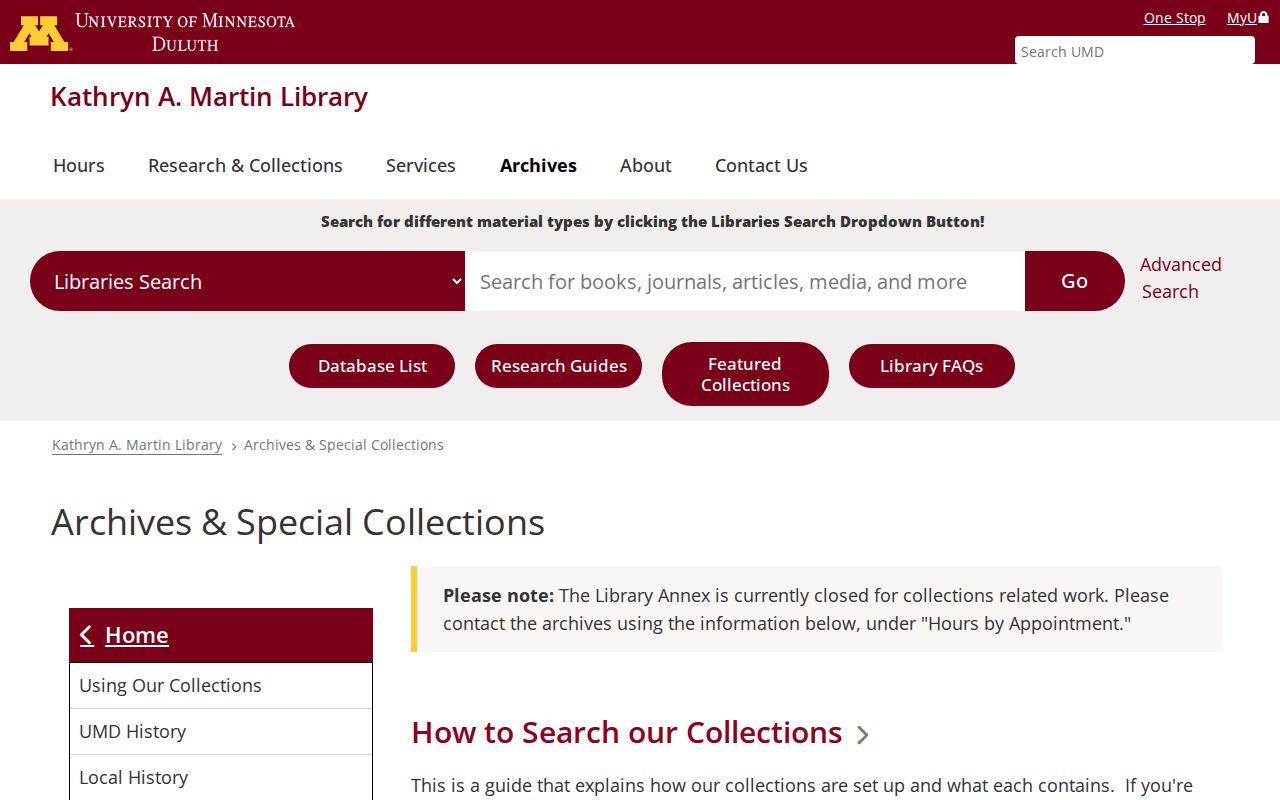
UMD's address-focused image index can give a Duluth directory entry a visual and architectural setting. Record the image description and date separately from the name and address in the directory.
Duluth Directory Archive Partners
The St. Louis County Historical Society remains a useful Duluth archival contact, although it reports that most archival materials are now at UMD Kathryn A. Martin Library Archives and Special Collections. Its Depot is at 506 W Michigan St, with office hours listed as Monday through Friday from 9 to 5 and doors at 10; call before visiting. Copies are for private study, scholarship, and research, and publication rights need a formal use contract.
The Historical Society archive information explains the current location and access limits for its collections.
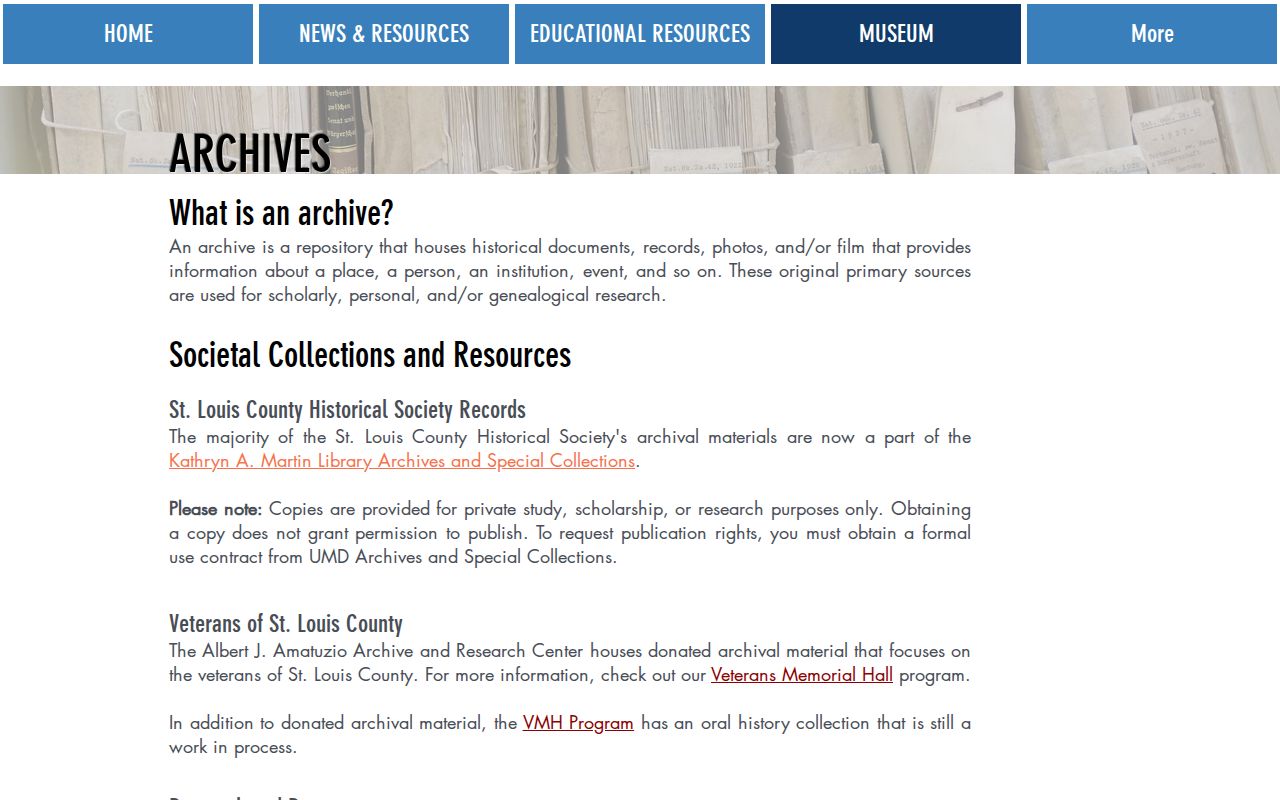
For a Duluth publication, memoir, or display, obtain permission from the collection that holds the material. For Duluth family-history research, keep the collection, image, page, and date in the citation so another reader can return to the same Duluth source.